Jenoh Johnson FR – version française CV (PDF) Menu

Jenoh Johnson

Software, data and DevOps engineer based in Nancy, France.

Production ETL (SSIS, Talend, SQL Server), C++ and Java back-ends at Amadeus, Azure DevOps CI/CD.

See the projectsGet in touch

Open to data / ETL, DevOps and software engineering rolesGrand Est, Paris, Luxembourg

I work where data moves from one system to another: production ETL, critical back-ends and automated delivery.

At Demathieu Bard, from 2025 to 2026, I designed and maintained SSIS and Talend flows between SQL Server, SharePoint, IBM i / AS400, REST APIs and Exchange Online, and automated their deployment with Azure DevOps.

Before that I developed C++ and Java on Unix / Linux booking back-ends at Amadeus, after a PL/SQL assignment on the IFS Cloud ERP.

MSc from EPITA. Open to data / ETL, DevOps and software engineering roles in Grand Est, Paris and Luxembourg. Get in touch

Experience

2018–2026 · France and India · 5 roles

–

Demathieu Bard

Software Engineer – Data / ETL & Integration

Montigny-lès-Metz, France

  • Designed, developed and maintained production multi-source ETL flows in SSIS and Talend 8 Pro across SQL Server, SharePoint, IBM i / AS400, REST APIs, Exchange Online, CSV files and FTP / SFTP exchanges.
  • Analysed business needs and turned business rules into mappings, transformations, consistency checks and SQL / T-SQL scripts.
  • Automated build and deployment of SSIS projects with Azure DevOps: Git repositories, YAML pipelines, self-hosted agents, ISPAC artefacts and deployment to SSISDB.
  • Made flows reliable with data-quality checks, reject handling, historisation and execution logging; wrote SQL correction scripts.
  • Analysed production incidents (SSIS reports, SQL Agent, Talend and PowerShell logs, API responses), traced root causes, documented fixes and secured releases.
  • Configured and troubleshot Talend Management Console (contexts, scheduled runs, tokens, HTTP errors, timeouts); automated Exchange Online distribution groups with PowerShell.
  • SSIS
  • Talend 8 Pro
  • SQL Server
  • T-SQL
  • Azure DevOps
  • YAML pipelines
  • PowerShell
  • SharePoint REST API
  • IBM i / AS400

–

Amadeus

Junior Software Developer – Backend / Cloud

Nice, France

  • Developed and evolved critical object-oriented C++ and Java back-ends on Unix / Linux for booking validation, storage and search, in an international Agile / Scrum team.
  • Reproduced and fixed defects, traced root causes and delivered fixes with unit, validation and non-regression tests; took part in code reviews.
  • Contributed to migrating applications to Microsoft Azure and OpenShift (Docker, Kubernetes, Argo CD): analysis of existing components, planning, connectivity tests and post-migration validation.
  • C++
  • Java
  • Unix / Linux
  • Microsoft Azure
  • OpenShift
  • Docker
  • Kubernetes
  • Argo CD
  • Agile / Scrum

–

Fekra Global Services

Technical Consultant Developer – IFS Cloud / PL/SQL

France

  • Developed and optimised Oracle PL/SQL and SQL queries to extract, transform and check the consistency of data; maintained IFS Cloud and built custom features.
  • Analysed requirements and wrote technical specifications for IFS Cloud ERP changes in an Agile / Scrum team.
  • Built Power BI dashboards for interactive data visualisation.
  • IFS Cloud
  • Oracle PL/SQL
  • SQL
  • Power BI
  • Agile / Scrum

–

Dietsmann Smart Labs R&D

Back-End Developer Intern – Data & Machine Learning

France

  • R&D image-processing project: wrote Python (OpenCV, Pandas, NumPy) to extract data from images, clean it and structure it for analysis.
  • Machine-learning prototypes with TensorFlow and scikit-learn: compared several approaches, ran technical tests and documented results and areas for improvement.
Full details
  • Took part in innovation workshops and brainstorming sessions, presented research results and worked with experts on projects of national scope.
  • Worked closely with the Insight & Data team: team meetings, knowledge sharing and support for other members.
  • Python
  • Pandas
  • NumPy
  • OpenCV
  • TensorFlow
  • scikit-learn
  • Jupyter Notebook

–

Sri Manakula Vinayagar Software Solutions

Software Developer – Web, Mobile & Desktop

Puducherry, India

  • Built web features (HTML5, CSS3, Bootstrap, Java), Android apps (Java, Android Studio) and Windows desktop apps in C# .NET Framework, backed by SQL Server and MySQL.
  • Designed relational schemas; created and maintained tables, relationships and SQL queries; checked the consistency of exchanged data.
  • Administered the databases: users and permissions, performance tuning, backups, restoration after failure and recovery tests.
Full details
  • Analysed requirements and took part in the technical design of the applications.
  • Ran functional tests, reproduced and fixed defects; wrote technical documentation for developments, fixes and databases.
  • Delivered and maintained the web, mobile and desktop apps in a V-model cycle.
  • C# .NET Framework
  • Java
  • Android Studio
  • HTML5
  • CSS3
  • Bootstrap
  • SQL Server
  • MySQL
  • Git

Full details are in the CV (PDF, in French).

Projects

Three personal projects documented end to end, then the archive of my GitHub repositories. The list adds new repositories from the GitHub API on load.

  1. ÉlanJob-search agent · TypeScript2026
  2. Customer HealthChurn pipeline and machine learning · Python, Next.js2026
  3. ReviewBayReview ETL and RAG chat · Python2026
  4. ReviewBay V2Snowflake, Cortex and Airflow variant · Python2026
  5. Customer health careCustomer health scores, FastAPI · Python2026
  6. Epita Web FrontendReact and Bootstrap app · EPITA2020
  7. Epita Web BackendExpress, Sequelize and JWT API · EPITA2020
  8. EverydayHealthiOS app · Swift2020
  9. Software industrializationREST quiz and tests · Java, EPITA2020
  10. EpiTrelloJava and Maven project · EPITA2020

All repositories on GitHub

Élan

A private, self-hosted job-search agent for France.

2026TypeScriptno public demo (personal data)

Élan architectureGitHub Actions triggers the daily search through the Next.js web service; the worker leases the task from PostgreSQL, queries the official adapters, normalises and deduplicates the jobs, applies a deterministic prefilter and, when a budget is configured, an AI analysis, then sends a daily digest.GitHub Actionscron 05:17 UTCWebNext.js 15 · React 19BrowserdashboardWorkerTypeScriptPostgreSQLtasks, leases, jobsAdaptersGreenhouse · LeverAshby · France TravailDaily digestemail · TelegramNormaliseand deduplicatePrefilterdeterministicOptional AIcapped budget
Élan Architecture as documented in the repository README. No screenshot: the app holds personal data.

The problem. Vacancies are scattered across applicant-tracking systems, career sites and France Travail, often duplicated. The goal was to gather them, deduplicate them and sort them against a reviewed profile, without circumventing any site’s access rules.

The flow, step by step

  1. GitHub Actions triggers the search every day at 05:17 UTC, so no personal computer has to stay on.
  2. The Next.js web service queues the search in PostgreSQL; the worker takes it with a lease and an ownership token.
  3. The worker queries the official adapters: Greenhouse, Lever, Ashby and the France Travail API.
  4. Jobs are normalised, then deduplicated (URL, company, title, location, description fingerprint).
  5. A deterministic prefilter drops exclusions, location, contract or salary mismatches before any model call.
  6. If a model, a key, exact prices and limits are configured, a schema-validated AI analysis ranks the remaining jobs.
  7. One idempotent daily digest goes out by email or Telegram.

Technical decisions

  • LinkedIn, Indeed, Welcome to the Jungle and others are marked unavailable rather than bypassed: no stored cookies, no CAPTCHA or rate-limit evasion.
  • PostgreSQL task leases with retry and backoff: a failing source is isolated and the others carry on.
  • No AI call without a budget: 30 requests and USD 2 a day by default.
  • Security: scrypt password hashing, revocable sessions, HTTP-only cookies, same-origin write checks, SSRF protection and robots.txt compliance.

Result. Code, Docker image (web and worker targets) and Railway deployment ready. Unit tests on offline fixtures and PostgreSQL integration checks in CI. The app starts empty: no fake vacancies.

Stack

  • Next.js 15
  • React 19
  • strict TypeScript
  • Tailwind CSS 4
  • Prisma 6
  • PostgreSQL 16
  • Zod 4
  • Docker
  • GitHub Actions
  • Railway

Customer Health

A cloud data pipeline that predicts churn risk and explains it.

2026Python, TypeScriptlive

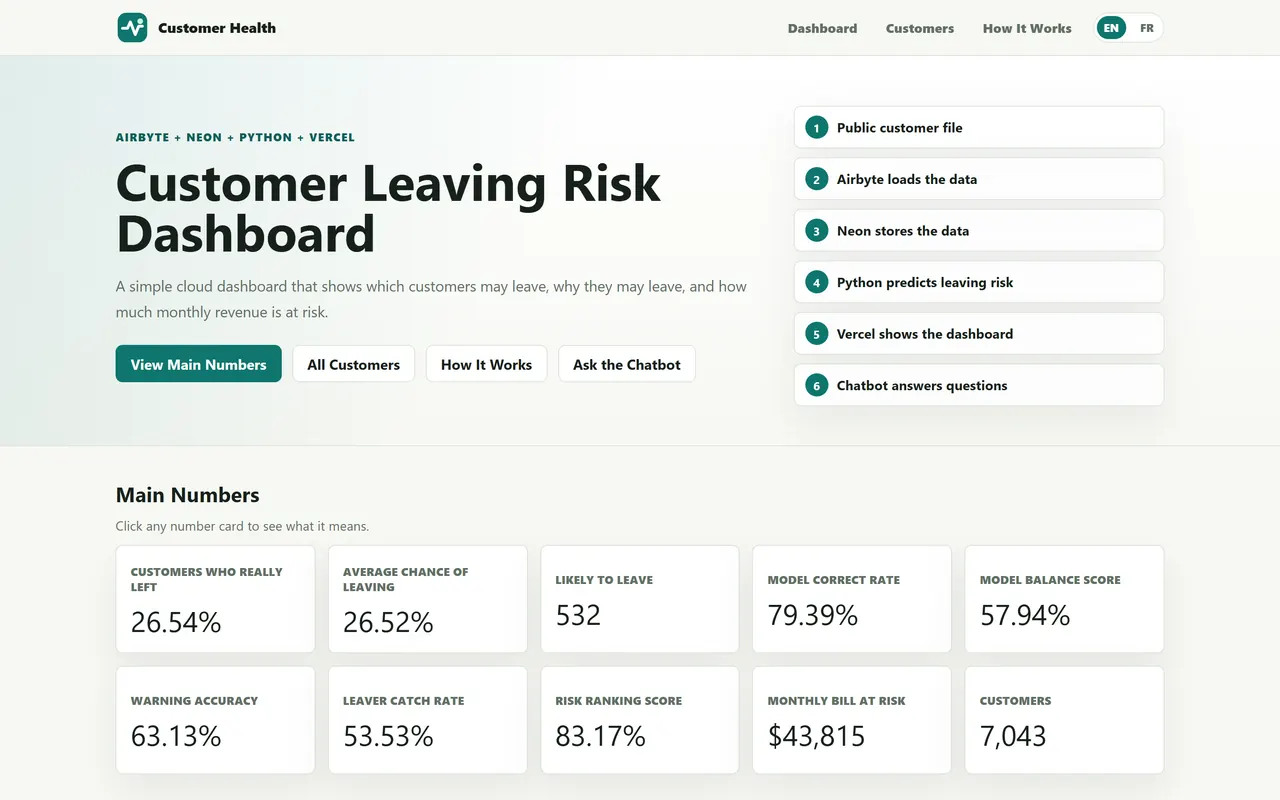
The live Customer Health dashboard: 26.54% churn rate, 532 high-risk customers, 79.39% model accuracy.Customer Health data pipelineAirbyte Cloud loads the public IBM Telco CSV into Neon; a Python pipeline on GitHub Actions cleans the data and trains a scikit-learn logistic regression; predictions and KPIs feed a Next.js dashboard on Vercel and an OpenAI chatbot.Public CSVIBM Telco churnAirbyte CloudHTTPS file sourceNeon · rawcustomer_churnPython · pandasGitHub Actionsscikit-learnlogistic regressionNeon · analyticspredictions, KPIsNext.js · Vercelread-only userChatbotOpenAI API
Customer Health, live The dashboard and the data pipeline that feeds it.

The problem. Answer one business question: which customers are likely to leave, and why?

The flow, step by step

  1. Airbyte Cloud reads the public IBM Telco Customer Churn CSV over HTTPS.
  2. Raw rows land in raw.customer_churn on Neon PostgreSQL.
  3. GitHub Actions runs the Python pipeline: cleaning and feature preparation with pandas.
  4. scikit-learn trains a logistic regression; 25% of customers are held out for testing.
  5. Predictions, KPIs and churn drivers are written to the analytics schema.
  6. The Next.js dashboard on Vercel reads those tables through a read-only user.
  7. An OpenAI chatbot answers questions from a small analytics context.

Technical decisions

  • Logistic regression: fast and interpretable, it gives probabilities and coefficients, shown as explained churn drivers.
  • Separate raw, staging and analytics schemas; the web app only has read access.
  • Readable risk bands: low under 40%, medium from 40 to 70%, high from 70%.
  • English and French interface.

Result. Live. On the public demo data, the dashboard shows 7,043 customers scored, 532 at high risk, 79.39% accuracy and a ROC AUC of 0.83 on the test set.

Limits. A prototype on public data: a production version would need private networking, model monitoring and drift detection.

Stack

  • Airbyte Cloud
  • Neon PostgreSQL
  • Python
  • pandas
  • scikit-learn
  • SQL
  • GitHub Actions
  • Next.js
  • Vercel
  • OpenAI API

ReviewBay

A review-intelligence ETL pipeline with a RAG chat that cites its sources.

2026Pythonlive

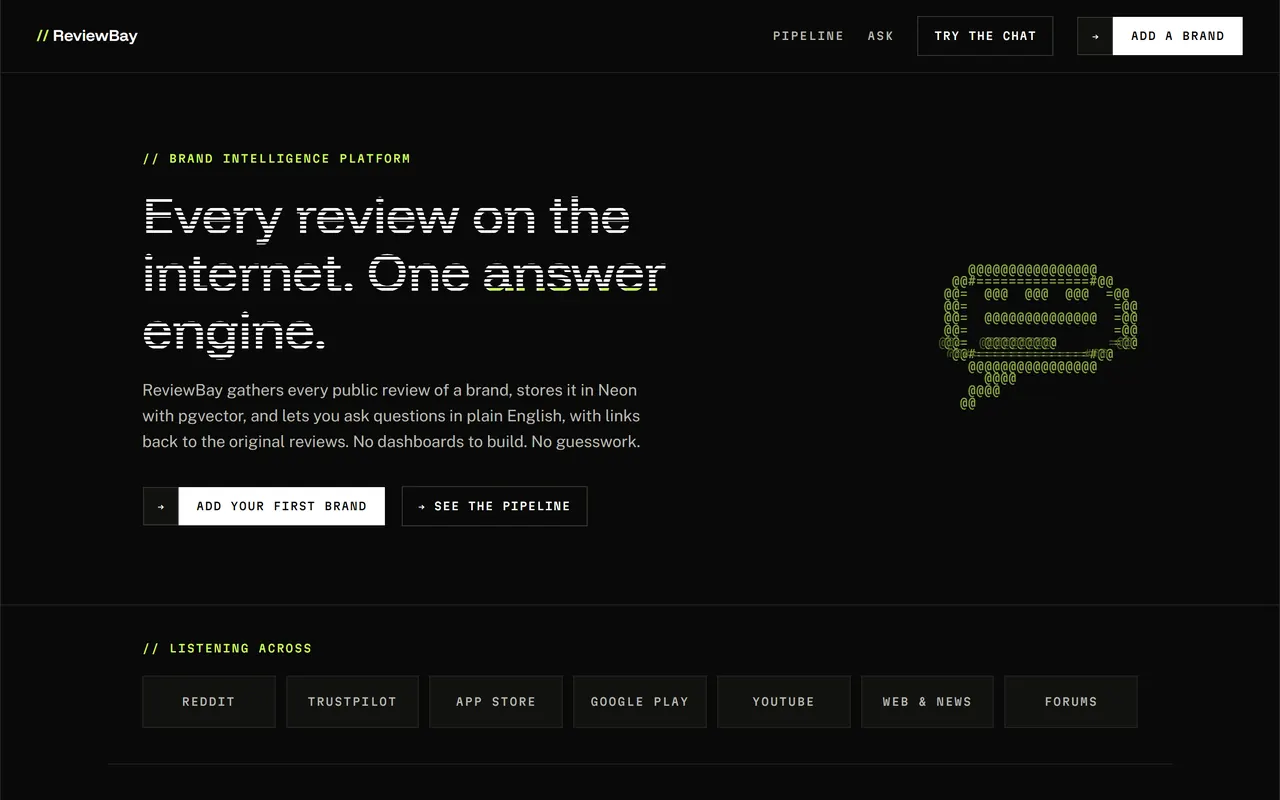
The live ReviewBay home page: “Every review on the internet. One answer engine.”ReviewBay data pipelinecollect_until queries open sources first; every review becomes a NormalizedReview, upserted idempotently into Neon, enriched with OpenAI embeddings and VADER sentiment and indexed with pgvector; FastAPI answers with citations back to the original reviews.Open sourcesTavily · HN · Mastodoncollect_untiltarget ~200 reviewsNormalizedReview+ source_urlraw.reviews_rawidempotent upsertEmbeddingsOpenAI 768 d · VADERmarts.reviewspgvector · HNSWFastAPI + RAGOpenAI ResponsesCited answer[n] links to reviews
ReviewBay, live The home page and the collection and enrichment pipeline.

The problem. What customers say about a brand is scattered across app stores, social networks and review sites, many of which block collection or charge for it.

The flow, step by step

  1. The collect_until orchestrator queries open sources first (Tavily web search, Hacker News, Mastodon, App Store, Google Play), with Apify only as a last resort, aiming for about 200 reviews.
  2. Every source yields the same NormalizedReview, which always carries its source_url.
  3. Idempotent upsert into raw.reviews_raw: the key is a hash of brand, source, URL and text.
  4. Enrichment: OpenAI text-embedding-3-small embeddings at 768 dimensions and local VADER sentiment.
  5. marts.reviews stores the vectors in pgvector with an HNSW cosine index.
  6. FastAPI retrieves the closest reviews and the OpenAI Responses API writes an answer in which every claim links to its original review.

Technical decisions

  • One interface per source: adding a source means adding a plugin, not rewriting the pipeline.
  • Production incident: the local embedding model (about 1 GB) crashed the cloud container as soon as enrichment started. Switching to the OpenAI embeddings API at 768 dimensions, a drop-in for the existing column, removed the crash and shrank the Docker image.
  • Dashboard summary built with scikit-learn (TF-IDF and KMeans), no LLM: fast, free and reproducible.
  • /healthz answers instantly; the database probe lives on /readyz, so the container is not restarted mid-enrichment.

Result. Live on Railway. The chat only answers from retrieved reviews, and says so when nothing matches.

Stack

  • Python
  • FastAPI
  • Neon PostgreSQL
  • pgvector
  • OpenAI embeddings and Responses API
  • VADER
  • scikit-learn
  • Docker
  • Railway

Toolkit

Data engineering and ETL

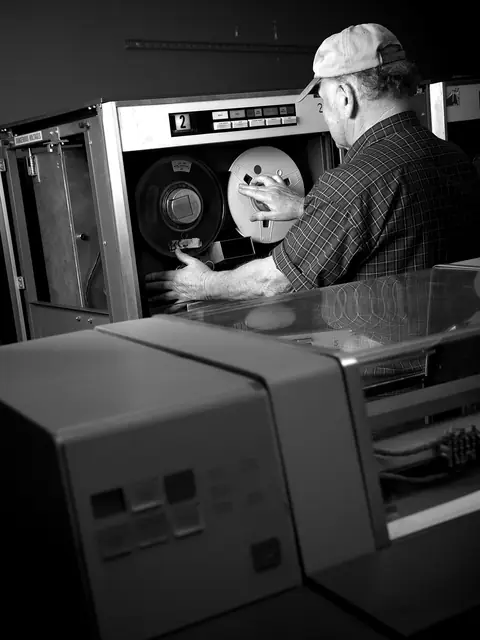
A restored IBM 729 magnetic tape drive, reels visible behind the glass.
IBM 729 tape drive, 1950s
  • SSIS, SSISDB and SQL Server Agent
  • Talend 8 Pro and Talend Management Console
  • KingswaySoft
  • Mappings, quality checks, rejects, historisation
  • Scheduling and run monitoring

Databases and SQL

An archive warehouse filled with thousands of boxes of IBM punched cards.
IBM punched-card storage, US National Archives
  • SQL Server and T-SQL
  • Oracle and PL/SQL
  • PostgreSQL and MySQL
  • Relational modelling
  • Power BI

Software engineering

The front panel of a PDP-11/70 minicomputer, rows of toggle switches.
PDP-11/70 front panel, the minicomputer Unix grew up on
  • Object-oriented C++ and Java
  • Python and C# .NET
  • PowerShell, Bash and YAML
  • Unix / Linux and Windows
  • Unit, integration and non-regression tests; code reviews

Cloud and DevOps

A row of interlocking levers in an old railway signal box.
Interlocking levers, Sourbrodt signal box
  • Azure DevOps: Repos, YAML pipelines, self-hosted agents
  • ISPAC artefacts and deployment to SSISDB
  • Git, Bitbucket and Jenkins
  • Microsoft Azure
  • Docker, Kubernetes, OpenShift and Argo CD

Integration

Telephone operators at work at a large switchboard, headsets on.
Switchboard operators, NIH Clinical Center
  • REST APIs, JSON, XML and CSV
  • SharePoint (REST API), Microsoft Graph and OAuth
  • Microsoft 365 and Exchange Online
  • FTP / SFTP
  • IBM i / AS400 and IFS Cloud (ERP)

Method

Requirements analysis, technical specifications, feasibility studies, acceptance testing, debugging, technical documentation, Agile / Scrum.

Learning

  • Apache Airflow
  • dbt
  • Databricks
  • Snowflake
  • Apache Spark / PySpark
  • Azure Data Factory
  • Apache Kafka
  • Apache Hadoop

Personal projects

  • TypeScript
  • Next.js
  • React
  • Prisma
  • FastAPI
  • Neon PostgreSQL
  • pgvector
  • Airbyte
  • GitHub Actions
  • Vercel
  • Railway

About

EPITA
Master of Science, Computer Software Engineering · 2019–2021 · France
Manakula Vinayagar Institute of Technology
Engineer’s Degree, Computer Science · 2014–2018 · India
Talend
Studio for Data Integration Advanced certification · 2025
LinkedIn Learning
Python certification · 2020
Languages
English C2 · French B1 · Tamil, native

After an engineering degree in computer science in India (Manakula Vinayagar Institute of Technology, 2014–2018) and a year of web, mobile and desktop development in Puducherry, I took a Master of Science in software engineering at EPITA (2019–2021).

Since then I have worked on systems where approximation is expensive: booking back-ends at Amadeus, then enterprise data flows at Demathieu Bard. I look for the root cause before writing the fix, and I ship every fix with its tests.

Right now I am learning the modern data stack: Apache Airflow, dbt, Databricks, Snowflake, Spark and Azure Data Factory.

I am looking for a data engineering, ETL, DevOps or software engineering role in Grand Est, Paris or Luxembourg.

Jenoh JohnsonSoftware, data and DevOps engineer · Nancy

A role, a project, a question? Write to me.

The message reaches my inbox directly; I reply to the address you give.